Government Backed Developers in the UAE
September 3, 2026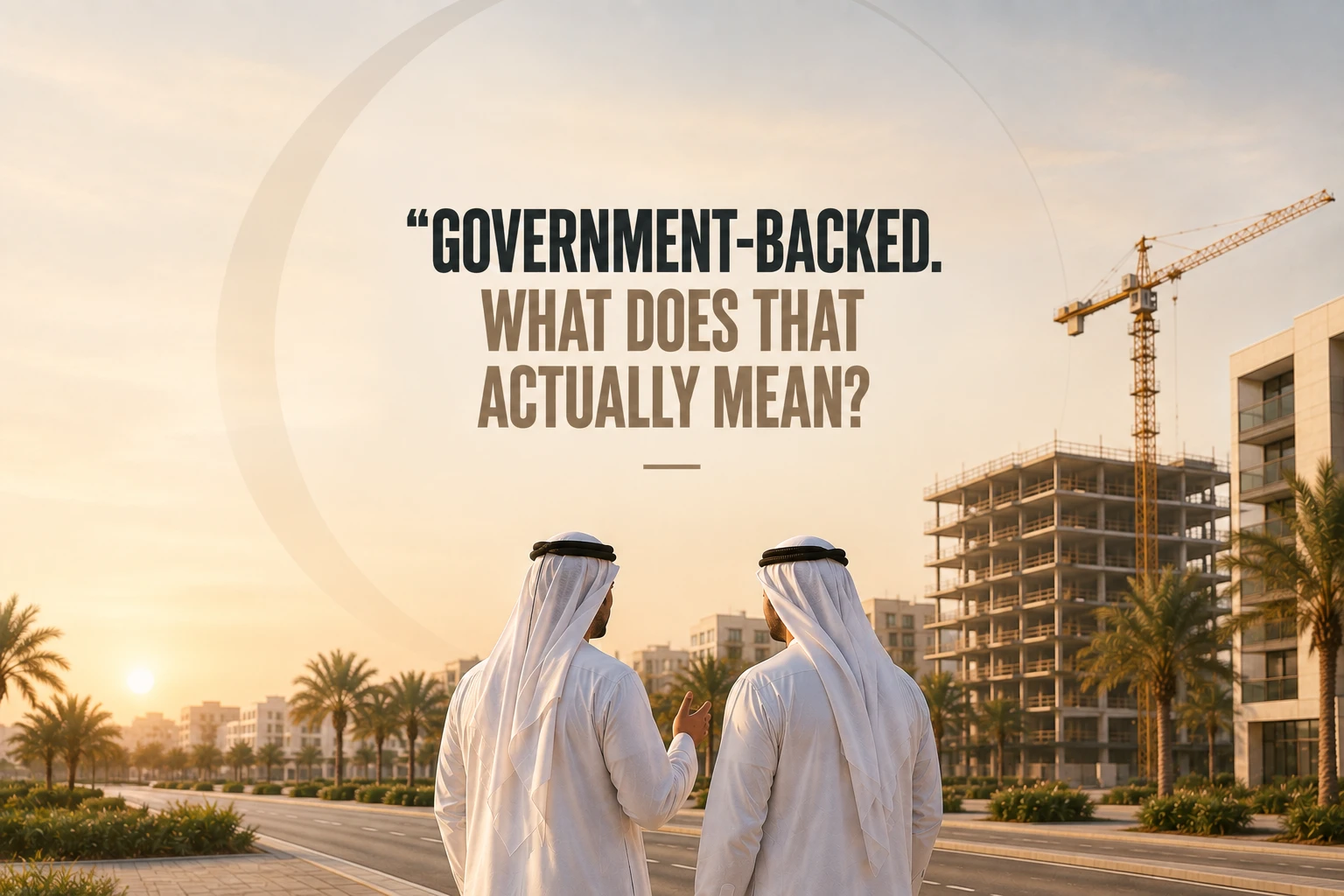
You have seen it on every brochure and every listing. "Government backed". It sits next to the project name like a seal of approval, and most buyers nod along without asking what it changes about the deal in front of them. The truth is more nuanced, and understanding it properly is one of the smartest things you can do before committing to a UAE property investment.
It Depends Where You Are
In many parts of the world, government involvement in a real estate project is not exactly a selling point. It can mean slower approvals, heavier bureaucracy, and policies that shift with every election cycle. A project stuck in "under review" for months is not unusual in some markets, and government ownership there often signals friction rather than reassurance.
The UAE plays by different rules. Government backed developers here are not slow-moving state bureaucracies. They are some of the most efficient, well capitalized, and internationally respected names in the industry, and that context changes everything about how the label should be read.
Why "Government Backed" Means Something Different Here
When a project in Dubai or Abu Dhabi is described as government backed, it usually points to one or more of these things.
Institutional strength. The developer may be government owned, government partnered, or building within a wider strategic masterplan set by the emirate itself. Emaar, for example, is publicly listed but remains closely tied to the Investment Corporation of Dubai. Nakheel, Dubai Properties, Meydan, Wasl Properties, and Dubai South all sit under government ownership or government linked structures. In Abu Dhabi, Aldar Properties plays a similar role as the emirate's largest master developer.
Major resources. These developers are not relying purely on presale revenue to fund construction. They have access to capital, land banks, and long-term financial support that smaller private developers simply do not have.
A wider masterplan. A government backed project is rarely an isolated tower. It usually sits inside a broader vision for the district, city, or emirate, which means the surrounding infrastructure is planned in parallel rather than as an afterthought.
Why That Actually Matters for Investors
This is where UAE real estate investment starts to differ meaningfully from other markets. When billions of dirhams are committed to roads, transport links, schools, utilities, and entire new districts around a development, that is not marketing language. It is a real signal about how the area is expected to grow over the next five to ten years.
If a government entity is investing in the connectivity and infrastructure around a project, it tells you something about where demand is likely to concentrate in the future. That is genuinely useful information for anyone doing serious due diligence on the Dubai property market or the wider UAE real estate landscape, because infrastructure investment tends to precede rental demand and capital appreciation, not follow it.
What Government Backing Does Not Fix
Here is the part most marketing conveniently leaves out. Government backing is a signal about the developer and the surrounding ecosystem. It is not a guarantee about the deal itself.
It does not fix overpricing. It does not fix oversupply in each micro location. It does not fix weak rental demand if too many similar units are competing for the same tenant pool. And it does not fix poor resale potential if the entry price was never justified in the first place.
Consider a simple example. If comparable properties in a community are trading at roughly AED 2,000 per square foot, and a new government backed launch is priced at AED 3,000 per square foot, the developer's credentials alone do not justify that gap. You still need to ask why the premium exists, whether it is backed by superior specifications, location, or amenities, and whether the market will pay it on exit. This is exactly the kind of comparison serious investors run before buying off plan property in Dubai, and it matters just as much whether the seller is a government entity or a private one.
The Real Takeaway
Government backing tells you something valuable about who is behind a project, what resources are supporting it, and how it fits into the UAE's long term development strategy. That context genuinely matters, and it is one of the reasons the UAE property market has built such a powerful reputation for stability and delivery compared to many other regions.
But it is a signal, not the thesis. A smart UAE property investment still needs to stand on its own fundamentals: fair pricing relative to comparable stock, realistic rental yield, genuine demand in that specific location, and a believable exit strategy. Government backing should support that analysis. It should never replace it.
How We Can Help You Navigate This
This is exactly where good advisory work earns its keep. Knowing that a developer is government backed is only the first filter. The real value comes from knowing which specific projects within that developer's pipeline are priced fairly, which locations are genuinely benefiting from upcoming infrastructure, and which launches are riding on the brand name alone.
We work closely with the UAE's leading government backed developers and can guide you through current and upcoming opportunities, including projects from Emaar, Nakheel, Dubai Properties, Meydan, Dubai South, Wasl Properties, and Aldar in Abu Dhabi. Whether you are looking at a master planned waterfront community, a transit connected district, or an early phase launch inside a larger strategic zone, we can walk you through the actual numbers, not just the credentials on the brochure.
If you are considering a UAE real estate investment and want a clear-eyed read on whether a government backed label is adding real value to a specific deal, reach out to us. We will help you separate the genuine signal from the sales pitch and connect you with the right project for your goals.
Popular Blogs
Yas Island’s AED 12B Expansion: Investor
The New Dubai: 10 Projects to Watch
ADGM’s $2.1 Trillion: Abu Dhabi Property
Dubai vs London vs Singapore: 2026 ROI C
5 Developers Offering Off-Plan Mortgages