Dubai 20/80 Payment Plan: Smart or Scam?
August 21, 2026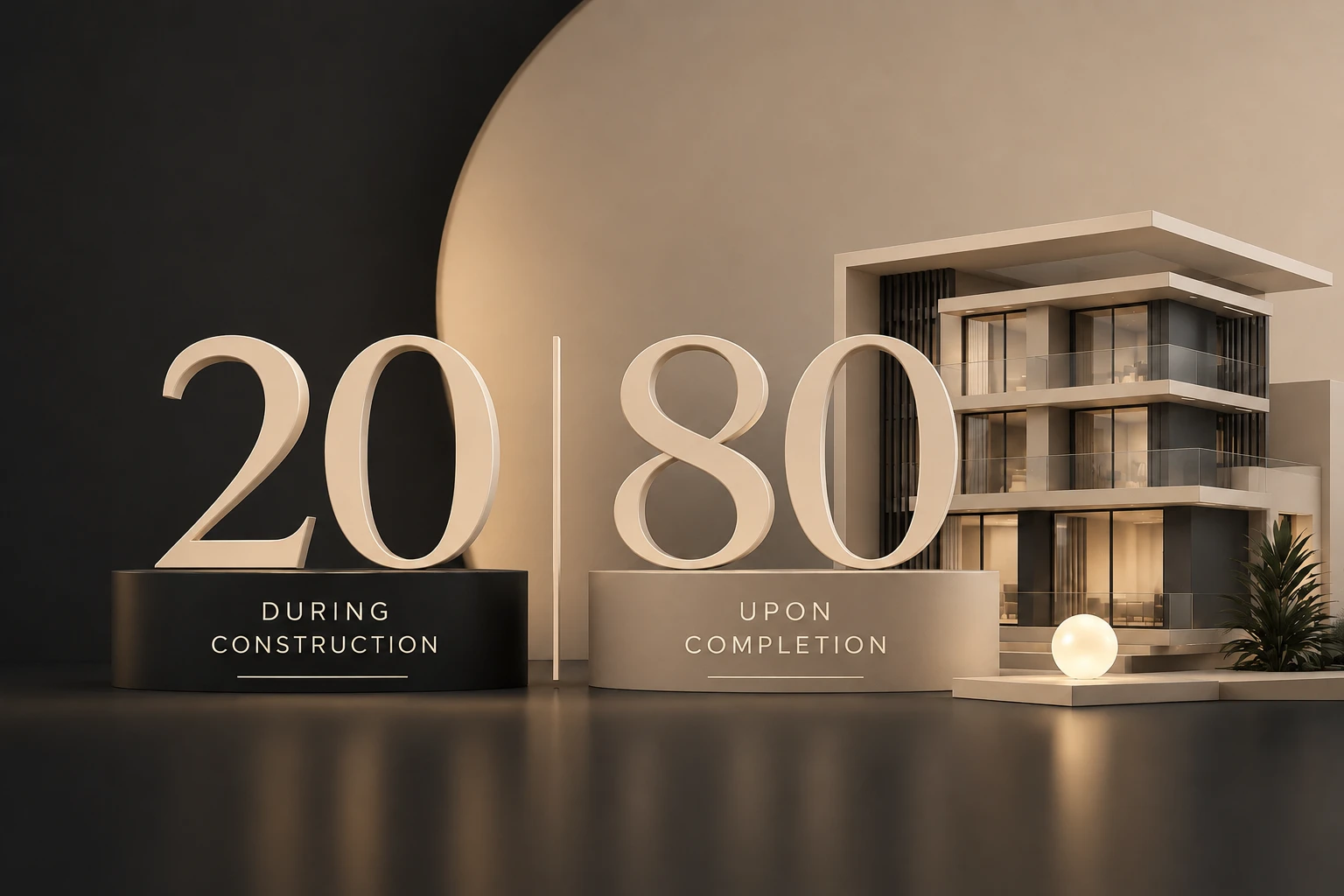
If you have been scrolling Instagram or TikTok lately, you have seen an agent breathlessly announcing a "20/80 payment plan" on a Sobha, Imtiaz, or Azizi project, pay 20% now, the rest at handover, deal of the century. It sounds too good to pass up. But before you comment on someone's reel or sign a reservation form, it is worth slowing down and checking whether this Dubai off-plan payment plan trend is a genuine opportunity or a well-dressed sales tactic.
First, let us fact-check the claim.
The facts are true. A 20/80 payment plan, 20% down payment, 80% deferred to handover, is a real structure currently being offered in the Dubai market, and Sobha Realty in particular has run these as limited-time promotions (sometimes bundled with a 4% DLD fee waiver) on select high-value units. It's also true that this is a departure from the norm: most Sobha, Azizi, and Imtiaz launches over the past two years have run on 60/40, 70/30, or 50/50 structures, with the buyer covering a much larger share of the price before the keys are handed over. So, the core observation, "why now, and why this shift?" is a fair and well-informed question, not an exaggeration.
Where it is right to raise a flag is the reasoning behind it. A construction-linked payment plan is, in effect, the developer financing part of its build through buyer instalments. When a developer pulls back from that model and asks for only 20% upfront, it usually means one of a few things: they have stronger balance-sheet liquidity and don't need buyer cash to fund construction, they're trying to accelerate sales velocity on a specific building or floor before a deadline, or they're competing hard against rival developers offering similar flexibility. None of these are automatically bad. But none of them are automatically good for you either, or that is the nuance a 30-second reel cannot capture.
Why "flexible" does not always mean "favourable”?
This is the part that deserves the most attention because it is genuinely sound investment logic. A 20/80 payment plan Dubai buyers are being pitched is not a discount, it is a shift in who carries the risk and when. Under a 60/40 or 50/50 plan, your capital is spread out and tied to construction milestones, so if a project slips or your circumstances change, your exposure at any given point is smaller. Under a 20/80 structure, you are committing to an 80% lump sum due on a single date year from now, a date that depends entirely on the developer hitting their handover timeline.
That is exactly why the second point matters: not every buyer's exit plan is "sell before handover." Plenty of investors assume they will flip the unit on the secondary market before that 80% balance comes due, collecting the difference as profit. But secondary-market appetite depends on market conditions, area demand, and how many similar units are being resold at the same time, none of which are guaranteed. If resale demand softens, or the project is delayed, you can end up needing to fund the full 80% yourself, via savings or a mortgage, at exactly the moment you were not planning for it. This is precisely why serious Dubai real estate investment planning requires more than one exit scenario: a Plan A (resell before handover), Plan B (refinance and hold as a rental), and Plan C (self-fund and occupy); rather than betting the whole strategy on flipping.
So, is it a fraud?
No, and it is worth being precise here: a 20/80 payment plan is not fraudulent, and Sobha, Azizi, and Imtiaz are all established, DLD-regulated developers with records of delivered projects. The structure itself is a legitimate financing tool, used by developers worldwide to move inventory. The risk is not in the mechanism; it is in buyers signing up for it without modelling what happens if their assumptions do not hold. The underlying warning, "people who want to back out because they didn't think it through and there was a lot of pressure from agents", reflects a real and common pattern in off-plan sales, where urgency ("only 48 hours," "only 3 units left") is used to shortcut due diligence. That pressure tactic is the part worth being sceptical of, not the payment plan itself.
What a smart buyer should check
Before committing to any off-plan property Dubai deal on flexible terms, run through this list:
- Which specific unit and building is the plan attached to, is it a slow-moving inventory clear-out, or genuinely prime stock?
- What was the original payment plan for that same project, and why has it changed?
- What is your realistic Plan B and C, not just Plan A (flip before handover)?
- What does the 80% cost you if you need a mortgage at handover, model the numbers, do not estimate them.
- Who is applying the time pressure, the developer's official channel, or an agent's marketing funnel?
The bottom line
This reflects genuinely sound, cautious investment thinking, the kind that is often missing in fast-paced off-plan sales conversations. The facts about 20/80 plans, and the shift away from 60/40 and 70/30 structures on certain inventory, check out. The healthy scepticism about why a developer offers it, and whether it suits your actual investment goals, is exactly the right instinct.
Where we can help is turning that instinct into a decision you can stand behind. If you are weighing a 20/80, 60/40, or any other Dubai payment plan, we can walk through the specific project, developer track record, and your own exit strategy: Plan A, B, and C; with real numbers before you commit a single dirham. A 15-minute conversation before signing is a lot cheaper than backing out after.
Thinking about a specific project on a 20/80 plan? Send us the details and we will break down whether it fits your goals, no pressure, no countdown clock.
Popular Blogs

Why People Choose to Buy Property in Dub

Your Guide to the UAE Golden Visa in 202

Cash vs Mortgage: Best Way to Buy in Dub

Dubai launches first home ownership plan

How Dubai’s 1% Payment Plans Work: Guide