Can Dubai Property Protect You From Currency Fluctuations?
June 16, 2026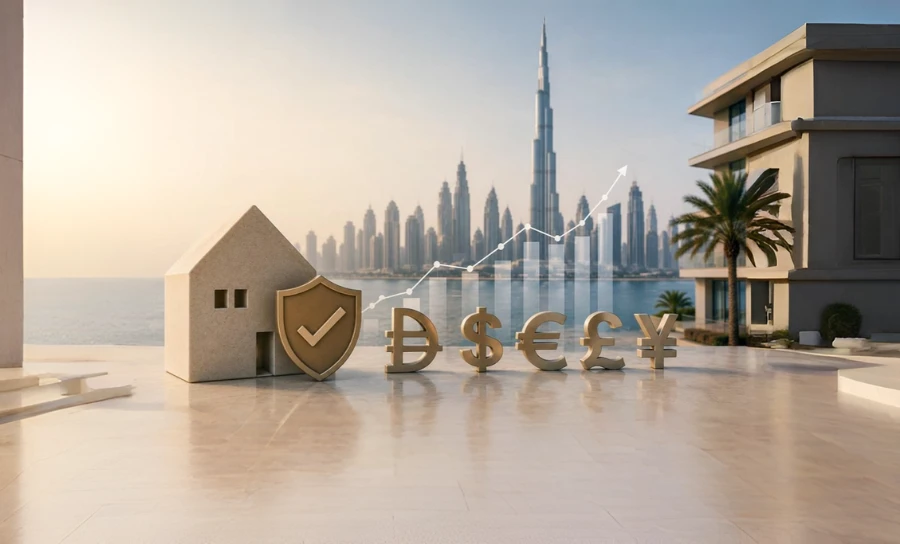
Why More Global Investors Are Choosing Dubai
When people invest in property overseas, they usually focus on prices, rental income, and future growth. However, there is another important factor that many investors often overlook, which is currency risk. A property investment may perform well, but if the investor’s home currency weakens or strengthens significantly, the final returns can change quite a lot.
This is one of the main reasons Dubai has become such an attractive destination for international investors. The UAE Dirham (AED) is pegged to the US Dollar, which means its value remains stable against the USD. This reduces uncertainty and gives investors more confidence when planning long term investments.
In 2025, Dubai recorded more than AED 917 billion in property transactions across over 270,000 deals. This represented growth of around 20 percent compared to the previous year. These figures show continued global trust in Dubai’s real estate market.
Understanding Currency Risk in Real Estate
Currency risk happens when exchange rates change between the currency you earn and the currency of your investment. In real estate, this risk becomes important for international investors.
For example, consider an investor from India who earns in Indian Rupees but buys a property in Dubai worth AED 1 million. All expenses, rental income, and resale value are in AED.
If the Indian Rupee weakens against the AED, the investor benefits because rental income and resale value convert into more Rupees. If the Rupee strengthens, returns may reduce when converted back.
Key point:
Currency movements can increase or decrease real returns, even if property performance stays strong.
Why Dubai Stands Out
Dubai attracts investors from India, the UK, China, Russia, Europe, and Africa. Since each investor operates in a different currency, stability becomes a major advantage.
Almost all property-related transactions in Dubai are conducted in AED, including:
Property purchase prices
Rental income
Service charges
Registration fees
Resale transactions
Because of this uniform currency system, investors avoid multiple layers of currency conversion within the market itself.
AED and the US Dollar Peg
The UAE has maintained a fixed exchange rate between the AED and the US Dollar for decades. This peg creates long term stability and reduces volatility.
For many investors, this means Dubai real estate behaves similarly to a USD-linked asset without actually investing in the United States.
Benefits of the AED peg include:
Stable long term pricing
Reduced currency volatility
Easier financial planning
Lower risk of sudden currency shocks
For example, investors from countries with weaker or fluctuating currencies often view Dubai property as a way to preserve purchasing power over time.
Strong Market Performance Adds Stability
A currency hedge becomes stronger when the underlying asset is also performing well. Dubai’s real estate market has shown strong growth in recent years.
In early 2026, Dubai recorded AED 252 billion in property transactions with over 60,000 deals completed. This reflects a highly active and liquid market.
Why this matters:
High transaction volume improves liquidity
Investors can buy and sell more easily
Market depth reduces exit risk
Strong demand supports long term value
A liquid market strengthens the effectiveness of any hedge because it allows investors to enter and exit with fewer barriers.
Rental Income as a Natural Hedge
One of the strongest advantages of Dubai real estate is its ability to generate regular rental income in AED.
This creates a steady cash flow that reduces dependence on exchange rate timing.
Examples of rental yields in Dubai communities:
International City: around 9 to 10 percent
Dubai Investments Park: around 9 percent
Discovery Gardens: around 9 percent
Town Square: around 7 to 9 percent
Al Furjan: around 7 to 8 percent
For example, a property purchased for AED 800,000 generating AED 64,000 annually delivers an 8 percent rental yield. Even if exchange rates fluctuate, consistent AED income helps stabilise overall returns.
Tax Advantages Strengthen Net Returns
Another key factor that supports Dubai’s appeal is its tax environment. The UAE does not impose personal income tax and generally does not apply capital gains tax for individual investors.
This creates clear advantages:
Higher net rental income
Greater retained profits
No annual income tax deductions
No capital gains tax on most property sales
In contrast, many global markets reduce investor returns significantly through taxation. This difference makes Dubai more attractive for long term wealth building.
However, investors should still account for:
Service charges
Maintenance costs
Registration fees
Mortgage-related costs
Even with these expenses, the overall tax structure remains highly competitive.
Limitations of Dubai as a Currency Hedge
While Dubai offers strong advantages, it is not a perfect hedge against currency risk.
Since the AED is pegged to the US Dollar, any movement in the USD against other currencies still affects international investors.
Key limitations include:
Exchange rate timing still impacts returns
Home currency strength can reduce gains when converting profits
Entry and exit timing matters significantly
Long term currency cycles can affect final outcomes
For example, if an investor buys when their home currency is weak and sells when it strengthens, real returns may be lower despite property growth.
How Investors Can Reduce Currency Risk
Investors can use several strategies to manage currency exposure more effectively.
Common approaches include:
Forward contracts: Lock in exchange rates for future transactions
AED-based financing: Matching rental income with mortgage payments in AED
Multi-currency accounts: Holding AED, USD, and other currencies strategically
Reinvestment strategy: Keeping income in AED to avoid unnecessary conversion
Rental income itself also acts as a natural buffer against currency fluctuations when used to cover ongoing costs.
Who Benefits Most From Dubai Property?
Dubai real estate is particularly suitable for:
Investors from countries with volatile currencies
Individuals seeking USD-linked exposure
Long term investors focused on wealth preservation
Landlords looking for stable rental income in AED
Global investors diversifying across markets
People considering future relocation to the UAE
However, it may not suit short term investors who require quick liquidity or rapid exits.
Final Thoughts
Dubai real estate can act as a practical hedge against currency risk, especially for international investors. The stability of the AED, its link to the US Dollar, strong rental yields, tax advantages, and global demand all contribute to its strength.
However, it is important to remember that no investment is completely risk-free. Currency movements still matter, and timing plays a role in overall returns.
The most effective approach is to treat currency protection as an added benefit rather than the sole reason to invest. When combined with strong location selection and long term planning, Dubai real estate
Popular Blogs

Why People Choose to Buy Property in Dub

Your Guide to the UAE Golden Visa in 202

Cash vs Mortgage: Best Way to Buy in Dub

Dubai launches first home ownership plan

How Dubai’s 1% Payment Plans Work: Guide