76% of Dubai Home Sales Are Off-Plan. Here Is What That Actually Means
May 9, 2026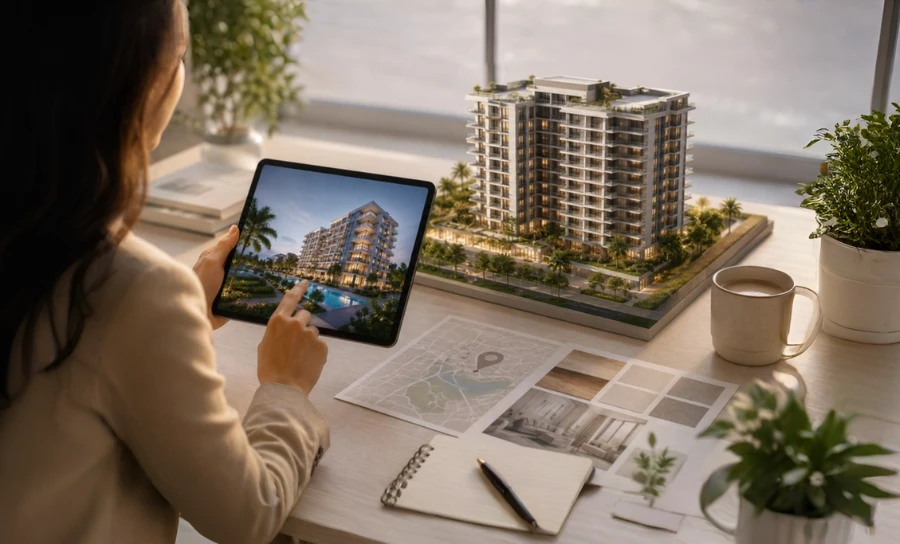
Dubai's residential real estate market closed April 2026 with solid numbers. Total transaction value reached AED 37.38 billion (roughly $10.18 billion) across 13,062 transactions. On the surface, that sounds impressive. But when you look a little closer at the data, there is a more nuanced story worth understanding, especially if you are thinking about buying, investing, or simply keeping an eye on where the market is heading.
The Headline Numbers
Month on month, transaction volumes grew by 1.59 percent compared to March 2026, and total transaction values edged up by 0.46 percent. These are not dramatic jumps. They are steady, incremental movements that suggest a market finding its rhythm rather than one racing ahead of itself.
That kind of stability is actually meaningful context. Dubai's real estate market has gone through periods of rapid growth followed by sharp corrections in the past. A market that grows slowly and consistently is generally a healthier sign than one that spikes sharply and unpredictably.
Off-Plan Is Clearly Leading the Market
The most significant takeaway from April's data is just how dominant the off-plan segment has become. Off-plan properties, meaning units sold before or during construction, accounted for 76.48 percent of total residential sales volume and 76.39 percent of total transaction value during the month.
In raw numbers, that translates to 9,990 transactions worth AED 28.55 billion. To put it simply, roughly three out of every four property sales in Dubai last month were off-plan.
So why are so many buyers and investors gravitating toward off-plan? A few reasons come up consistently in the market:
Phased payment plans make off-plan properties more accessible. Instead of needing the full amount upfront, buyers typically pay in installments tied to construction milestones. This lowers the immediate financial barrier.
Newly launched communities are attracting attention because they often come with modern amenities, planned infrastructure and competitive entry prices compared to ready properties in established areas.
Infrastructure-led development is another pull factor. Areas like Dubai South and Dubai Islands are being built around long-term strategic plans, which gives buyers confidence that surrounding development will continue to grow around their investment.
Where Is Activity Happening?
The report from Springfield Properties highlights some clear geographic trends. Dubai South recorded the highest transaction volume in April with 1,140 transactions. Jumeirah Village Circle followed with 797 transactions, and Dubai Islands came in third with 693 transactions.
DAMAC Lagoons and Dubai Creek Harbour also saw healthy activity, reinforcing the appetite for lifestyle-oriented communities with waterfront or resort-style features.
What is interesting about this list is that several of these areas are relatively newer or still developing. Dubai South, for instance, is being built around the Al Maktoum International Airport expansion, which is one of the largest infrastructure projects in the region. Buyers in these areas are essentially betting on where Dubai will be five to ten years from now, not just where it is today.
What About the Secondary Market?
It would be easy to overlook the secondary market given the off-plan dominance, but it still recorded 3,072 transactions valued at AED 8.83 billion in April. That is a meaningful level of activity concentrated in established residential communities.
The secondary market tends to attract a different buyer profile, typically end-users looking for completed homes they can move into, or long-term investors who prefer the certainty of an existing asset over a unit that is still being built.
Pricing in the secondary market tells its own story. Secondary villas averaged AED 2,406 per square foot, which is actually higher than off-plan villas at AED 2,293 per square foot. This premium reflects the value buyers place on ready, completed communities where they can see exactly what they are getting.
Pricing Across the Board
Off-plan apartments averaged AED 2,111 per square foot in April, while off-plan villas reached AED 2,293 per square foot. These numbers have remained broadly firm, which signals that demand is holding up without the kind of price pressure that would suggest an oversupplied market.
The sales mix also showed broad participation. Properties priced between AED 1 million and AED 3 million made up 53.62 percent of transactions with recorded values, while properties above AED 5 million also maintained stable activity. This spread across price points suggests the market is not just driven by ultra-high-net-worth buyers but also by a wider pool of mid-market participants.
Beyond Residential: Commercial Demand Is Also Active
April also saw notable activity in Dubai's commercial real estate sector, which recorded AED 10.35 billion across 963 transactions. Office transactions alone accounted for AED 3.34 billion across 428 deals. This is a signal that the demand for real estate in Dubai is not purely residential. Businesses are also continuing to establish and expand their presence in the city, which in turn supports longer-term residential demand as the working population grows.
A Final Thought
Looking at April's numbers analytically, the picture that emerges is one of a market in a steady, healthy phase rather than a hot or overheated one. The off-plan segment's dominance is real and it is growing, but it is being driven by genuine structural factors like payment accessibility, planned infrastructure and community-led development, not just speculation.
That said, anyone looking at off-plan property in Dubai today should keep a few things in mind. Construction timelines can shift. Developer quality varies significantly. And the areas attracting the highest volume of transactions today are still developing, meaning the surrounding amenities and connectivity that buyers are betting on may take years to fully materialise.
The market fundamentals look solid. Population growth, international demand and the city's continued investment in infrastructure all support a positive medium-term outlook. But solid fundamentals do not eliminate risk entirely. They just make the risk more manageable for a well-informed buyer.
Dubai's off-plan market is rising. The data confirms that clearly. Whether that rise continues at the same pace, accelerates or levels off will depend on how global economic conditions evolve, how quickly new supply comes to market, and whether developers can deliver on the communities they are selling today.
For now, the numbers suggest a market that is moving forward deliberately rather than recklessly. That is worth paying attention to.
Popular Blogs
Why People Choose to Buy Property in Dub

Your Guide to the UAE Golden Visa in 202
Cash vs Mortgage: Best Way to Buy in Dub

Dubai launches first home ownership plan

How Dubai’s 1% Payment Plans Work: Guide